For RVers, the hum of a generator isn't just noise; it's the heartbeat of their mobile home, powering everything from a morning coffee to a cool night's sleep. But picking the right one? That’s where many get stuck, intimidated by watts, amps, and volts. This comprehensive guide on Sizing Your RV Generator: A Wattage Requirement Guide isn't about baffling you with jargon; it's about empowering you to make an informed choice, ensuring your adventures are powered reliably, safely, and efficiently.
No one wants to be caught off-grid with an overloaded generator sputtering to a halt, or lugging around an oversized unit that burns fuel unnecessarily. Getting your generator's wattage right is fundamental to enjoying all the comforts your RV offers, whether you're boondocking in the wilderness or cruising cross-country.
At a Glance: Key Takeaways for Sizing Your RV Generator
- Prioritize Startup Wattage: Appliances like air conditioners and microwaves demand significantly more power to start (surge loads) than to run. Your generator must handle these spikes without overloading.
- The AC is Often the Decider: Your RV's air conditioner typically has the highest startup wattage, often dictating the minimum generator size you'll need.
- Don't Skimp, But Don't Overkill: Aim for a generator with a little more wattage (500-1000 watts) than your calculated maximum need to provide a buffer for unexpected demands or future upgrades.
- Understand Your RV's Amperage: 30-amp RVs generally need generators up to 3,600 watts, while 50-amp RVs may require 12,000 watts or more, especially for multiple ACs.
- Smart Power Management is Key: Learn to stagger appliance use, use soft-start modules for ACs, and leverage parallel inverter generators to maximize your power output and fuel efficiency.
- Inverter Generators Reign Supreme: For RVs, inverter generators offer stable power for sensitive electronics, better fuel efficiency, and significantly quieter operation compared to conventional models.
The Unseen Power Play: Why Generator Sizing is Your RV's Lifeline
Imagine pulling into a stunning, secluded campsite, ready to unwind. You fire up your generator, flip a few switches, and... nothing. Or worse, the generator sputters, chokes, and dies. This frustrating scenario often boils down to one thing: an improperly sized generator. Your RV isn't just a vehicle; it's a home on wheels, packed with various appliances, each with its own power appetite. From the chilling hum of your refrigerator to the comforting blast of your air conditioner, a reliable power source is non-negotiable for a truly enjoyable RV experience.
The core challenge in generator sizing comes down to understanding the difference between running watts and starting watts (often called surge watts). While many appliances hum along on relatively low running watts, they demand a powerful jolt of electricity for a split second when they first kick on. This initial surge can be 2-3 times higher than their running wattage. Your generator needs to absorb this surge without tripping its circuit breaker or damaging itself.
Demystifying RV Electricity: Watts, Volts, and Amps Made Simple
Before we dive into specific appliance needs, let's quickly clarify the fundamental terms you'll encounter. Think of electricity like water flowing through a pipe:
- Volts (V): The Pressure. This is the "push" that makes electricity flow. In the US, standard RV systems typically operate at 120 volts.
- Formula: Volts = Watts ÷ Amps
- Example: A 500-watt device pulling 25 amps would need 20 volts (500W ÷ 25A = 20V).
- Amps (A): The Flow Rate. This measures the amount of electrical current flowing through a circuit. RV systems are commonly rated for either 30 amps or 50 amps, indicating the maximum current they can safely handle.
- Formula: Amps = Watts ÷ Volts
- Example: A 3,600-watt device on a 240-volt system would draw 15 amps (3,600W ÷ 240V = 15A).
- Watts (W): The Total Power (Your Focus!). This is the unit of power that measures the rate at which energy is produced or consumed. When we talk about generator size, we're talking about its maximum wattage output. It's the overall "work" being done.
- Formula: Watts = Volts x Amps
- Example: An 1,800-watt device on a 120-volt system would draw 15 amps (1,800W ÷ 120V = 15A).
For generator sizing, watts are your primary concern, but understanding how volts and amps contribute helps you grasp the bigger picture of your RV's electrical system.
What Really Draws Power? Your RV's Appliance Wattage Appetite
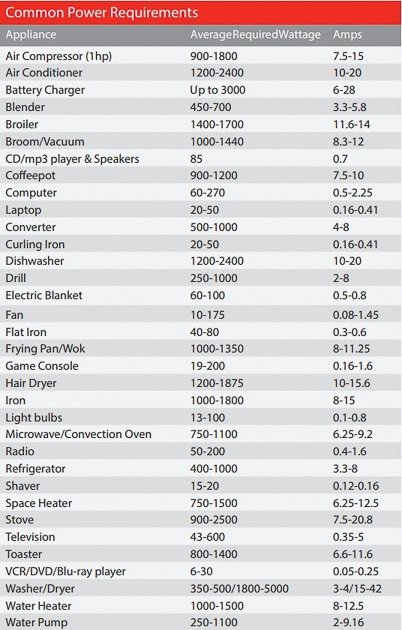
Every appliance in your RV has a specific power requirement. It's crucial to list out what you plan to run and note their individual wattages. Remember, the startup wattage is what your generator needs to handle, not just the running wattage.
Here are some common RV appliance wattage estimates (focusing on their higher startup needs):
| Appliance | Estimated Startup Watts (Surge Load) | Notes |
|---|---|---|
| Air Conditioner | 1,600 - 2,300 watts | Often the highest power draw; crucial for sizing. |
| Microwave | 1,000 - 1,500 watts | Used intermittently but with a significant surge. |
| Refrigerator (AC mode) | 600 - 800 watts | Cycles on and off, creating smaller surges. |
| Toaster | 1,080 watts (approx. 9A @ 120V) | Quick burst of high power. |
| Coffee Maker | 600 - 1,000 watts | Depends on type (drip vs. single-serve). |
| Hair Dryer | 1,000 - 1,800 watts | High draw, often used for short periods. |
| TV (LED) | 50 - 200 watts | Low, steady load. |
| Lights (LED) | 5 - 20 watts per fixture | Very low, steady loads. |
| Phone/Laptop Chargers | 20 - 100 watts | Low, steady loads. |
| RV Furnace (12V) | 84 watts (approx. 7A) | Operates on 12V DC, but internal blower fan has a small draw (often powered by the RV's battery, charged by gen). |
| The AC Factor: Your Generator's Litmus Test | ||
| Notice a pattern? Your air conditioner stands out. Its massive startup draw is usually the defining factor when choosing your generator size. If your generator can comfortably start and run your AC, it can likely handle most other appliances, provided you manage your power wisely. |
Your Personal Power Blueprint: Calculating Your RV's Wattage Needs
Ready to get specific? Here's a straightforward, three-step process to determine your RV's wattage requirements:
Step 1: List Every Electrical Gadget You'll Run
Grab a notepad or open a spreadsheet. Walk through your RV and list everything you might want to power with your generator. Think about:
- Essentials: Refrigerator, lights, furnace fan, water pump (if electric).
- Comforts: Air conditioner, microwave, coffee maker, TV, hair dryer.
- Electronics: Laptop, phone chargers, portable speakers.
Step 2: Estimate Each Appliance's Wattage
For each item on your list, find its wattage. You can usually find this information on:
- Appliance Labels: Look for stickers or plates on the appliance itself.
- User Manuals: Often listed in the specifications section.
- Online Search: A quick search for "[Appliance Name] wattage" usually provides estimates.
Crucially, prioritize the startup wattage for appliances with motors (like your AC, microwave, fridge). If you can only find running watts, estimate startup watts by multiplying by 2 or 3 for motor-driven items. - Quick Wattage Benchmarks:
- 2,000-watt generator: Good for basic lights, TV, and charging devices. Might run a small microwave if nothing else is on.
- 3,000+ watt generator: Can power more substantial loads, often including a single AC unit and other essentials.
- Small trailer owners: Often find 2,000-2,400 watts sufficient for basic needs.
- Travel trailer owners: Typically need 3,500-4,500 watts.
- Fifth-wheel owners: Usually require 4,500-6,000 watts.
- Motorhome owners: May need 4,000-7,000 watts, with larger units sometimes requiring even more.
Step 3: Summing Up Your Total Wattage (The "Worst-Case" Scenario)
This is where the rubber meets the road. You need to consider what you'll run simultaneously. Don't just add up every single appliance you own. Instead, think about your maximum concurrent usage.
Here's the trick:
- Identify your single highest startup wattage appliance (usually the AC). Let's call this Appliance A.
- List the running wattages of all other appliances you might use at the same time as Appliance A.
- Add the startup wattage of Appliance A to the running wattages of all other concurrently used appliances.
Example Scenario:
Let's say you want to run your 15,000 BTU RV air conditioner and then quickly heat a meal in the microwave while the AC is still running.
- Air Conditioner (Startup): ~2,000 watts
- Microwave (Running): ~1,200 watts
- Refrigerator (Running): ~150 watts (after initial surge)
- Lights & Electronics (Running): ~200 watts
Your maximum simultaneous draw would be: 2,000 (AC startup) + 1,200 (microwave) + 150 (fridge) + 200 (lights) = 3,550 watts.
This calculation gives you a strong indication of the minimum continuous wattage your generator should be able to provide.
Right-Sizing by RV Type and Amperage
Your RV's size and its electrical service rating (30-amp or 50-amp) also play a significant role in determining your generator needs.
General Generator Wattage Estimates by RV Type:
- Small Trailers (Pop-ups, Teardrops): Often just need enough power for basic lights, charging, and perhaps a small fan. A 2,000–2,400 watt portable generator is usually plenty.
- Travel Trailers: With more appliances, a single AC, and perhaps a microwave, you'll step up your needs. Look for 3,500–4,500 watt generators.
- Fifth Wheels: These larger rigs often have more amenities, including larger refrigerators and possibly a second AC unit. You'll likely need 4,500–6,000 watts.
- Motorhomes (Class A, B, C): Built-in generators are common here, supporting multiple ACs, entertainment systems, and residential appliances. Requirements range from 4,000–7,000 watts, with luxury coaches potentially needing up to 12,000 watts or more.
Matching Your Generator to Your RV's Amperage:
The electrical service rating of your RV (30-amp or 50-amp) essentially tells you how much power your rig is designed to handle.
- 30-Amp RVs: These rigs are typically designed to draw a maximum of 3,600 watts (30 amps x 120 volts).
- Recommended Generator Size: A generator providing up to 3,600 watts is appropriate. While your RV can only draw 3,600W, choosing a generator in the 6,000–8,000 watt range can provide extra capacity and ensure it doesn't struggle with surge loads, offering greater flexibility. You can then use an adapter to connect it to your 30-amp shore power inlet.
- 50-Amp RVs: These are set up for higher power demands, capable of drawing up to 12,000 watts (50 amps x 240 volts, often delivered as two separate 50-amp, 120-volt lines). This configuration allows for running multiple high-draw appliances simultaneously, like two air conditioners.
- Recommended Generator Size: For a 50-amp RV, you'll likely need a generator that can deliver 10,000–15,000 watts to comfortably power everything, especially multiple ACs or other high-demand appliances.
The "Buffer Zone": Always Go a Little Bigger
After calculating your total wattage needs, it's wise to select a generator that's slightly larger than your estimated requirement—say, an extra 500 to 1,000 watts. This buffer accounts for: - Unforeseen Needs: You might add a new appliance later or have guests with their own devices.
- Generator Efficiency: Generators run most efficiently at around 75-80% of their maximum load. Pushing them to 100% consistently can shorten their lifespan.
- Altitude & Temperature: Generators can lose efficiency at higher altitudes or in extreme heat, reducing their effective output.
This slight oversizing prevents overload issues, extends your generator's life, and gives you peace of mind.
Smart Power Management: Stretching Your Watts Further
Having the right generator is just one piece of the puzzle. How you manage your power consumption makes a huge difference in your RV experience.
Staggering Appliance Use: The Golden Rule
Avoid turning on all your high-wattage appliances at once. This is the quickest way to trip a breaker or overload your generator.
- AC First: If you need air conditioning, turn it on alone. Let the compressor start and the unit stabilize.
- Then the Microwave: Once the AC is humming, then you can safely use the microwave.
- Avoid Overlapping High-Draws: Don't run the microwave while the AC is trying to start, or use a hair dryer while the electric water heater is actively heating.
- Turn Off When Not In Use: Simple, but effective. Turning off lights, chargers, and small appliances when not needed significantly reduces your overall power draw and conserves fuel.
Soft Start Modules: An AC's Best Friend
Your air conditioner's massive startup surge is often the biggest hurdle for smaller generators. A soft start module (also known as an EasyStart) is a game-changer. This small device, installed on your AC unit, gradually ramps up the power to the compressor, dramatically reducing the startup wattage by up to 40%.
- Benefit: Allows a smaller generator (e.g., a 2,200-watt inverter generator) to power an RV air conditioner that it otherwise couldn't handle, opening up more flexible power options.
Parallel Inverter Generators: Flexible Power on Demand
If you have occasional high-wattage needs but don't want to carry a massive, heavy generator all the time, consider two smaller inverter generators that can be run in parallel.
- Benefit: Provides flexible power. You can run one generator for basic needs (charging, lights) and then connect a second one in parallel when you need to power your AC or microwave, effectively doubling your output. This offers portability and efficiency.
- Want to learn more about choosing the best power solution for your rig? Check out our guide on finding the best generator for your RV.
Energy-Saving Habits: Every Watt Counts
- LED Lighting: If you haven't already, upgrade to LED lights. They consume a fraction of the power of traditional incandescent bulbs.
- Monitor Battery Levels: Keep an eye on your RV's battery charge. Using 12-volt appliances (like your furnace fan or water pump) when connected to shore power or a generator helps prevent draining your house batteries too quickly.
- Adjust High-Draw Appliance Use: If you have an electric water heater, consider switching it to propane if you're trying to conserve generator power, or only turn it on when needed.
Your Generator Options: Built-in vs. Portable, Conventional vs. Inverter
The type of generator you choose also impacts your RV experience, from noise levels to fuel efficiency.
Portable Generators: Flexibility on the Go
- Watts: Typically 2,000 to 4,000 watts.
- Pros: Easy to move and position away from your RV for noise reduction (within safe limits), can be used for other purposes (home backup, tailgating), generally more affordable.
- Cons: Requires manual setup and fueling, security risk if left unattended, some can be quite noisy.
- Fuel Types: Commonly gasoline, but many dual-fuel (gasoline/propane) options are available.
Built-in Generators: Integrated Powerhouse
- Watts: Commonly 4,000 to 12,000 watts.
- Pros: Integrated into the RV's electrical system, often quieter than portable units (especially diesel models), fueled directly from the RV's main fuel tank (gas or diesel) or propane system, remote start capabilities.
- Cons: More expensive, fixed in place, heavier, and requires professional installation/maintenance.
- Common on: Larger travel trailers, fifth wheels, and motorhomes.
Conventional vs. Inverter Generators: The Quality of Power
This distinction is crucial, especially for modern RVs with sensitive electronics.
- Conventional Generators:
- Produce 120V power at a fixed 60Hz.
- Drawback: The power output might be less "clean" or stable, which can potentially harm sensitive electronics (laptops, TVs, medical devices).
- Efficiency: Run at a constant engine speed regardless of load, making them less fuel-efficient and louder.
- Size/Weight: Generally heavier and larger for their power output.
- Inverter Generators:
- Convert raw engine power to DC, then back to clean, stable AC power (often called "pure sine wave").
- Benefit: Provides highly stable and safe power for all your electronics.
- Efficiency: Adjust engine speed based on the power demand, making them significantly more fuel-efficient and much quieter.
- Size/Weight: Lighter and more compact for their power output.
- Features: Often include convenient features like one-button start, eco-mode, and easy monitoring systems.
- Recommendation: For RV use, inverter generators are almost always the superior choice due to their clean power, quiet operation, and fuel efficiency.
Fueling Your Adventures: Generator Fuel Types & Capacities
The type of fuel your generator uses impacts its efficiency, noise, emissions, and how long it can run.
- Gasoline Generators:
- Pros: Widely available, generally more affordable generators, offer maximum wattage output.
- Cons: Can be noisy, produce more emissions, fuel degrades over time (especially with ethanol), requires separate fuel storage for portable units.
- Capacities: Typically 2.8 to 7.0 kilowatts (2,800 to 7,000 watts) for common RV use.
- Diesel Generators:
- Pros: Most powerful and fuel-efficient, excellent for larger RVs, typically quieter and have lower emissions than gasoline, integrated into the RV's main fuel tank for built-in units.
- Cons: More expensive to purchase, diesel fuel is dirtier to handle.
- Capacities: 6.0 to 12.5 kilowatts (6,000 to 12,500 watts).
- Propane Generators:
- Pros: Clean burning, quieter than gasoline, low emissions, fuel has a long shelf life (great for off-grid), safe and easy to use (especially if your RV already has a propane tank).
- Cons: Slightly lower power output (around 10-15% less) compared to gasoline for the same engine size, propane can be harder to find in some remote areas, requires carrying propane cylinders for portable units.
- Capacities: 2.5 to 6.5 kilowatts (2,500 to 6,500 watts).
- Solar-Powered Generators (Battery Banks):
- Pros: Eco-friendly, completely silent, no emissions, virtually no maintenance.
- Cons: Limited power output (especially for high-draw items like AC), requires significant roof space for solar panels, high initial investment, dependent on sunlight.
- Use Case: Excellent for powering low-draw essentials and charging, often used in conjunction with a small fuel-based generator for occasional AC use.
If your RV already has a large propane tank, a dual-fuel (gasoline and propane) generator can offer the best of both worlds, giving you fuel flexibility and extended runtimes.
Key Factors When Buying Your RV Generator
Once you have your wattage requirement figured out, consider these practical aspects when making your final purchase decision:
- Noise Level: This is huge for campsite etiquette and your own peace of mind. Target generators in the 50-60 decibel range at typical operating distances. Inverter generators are generally much quieter than conventional ones.
- Fuel Efficiency: How long can it run on a tank of fuel? Inverter generators excel here because they only run as fast as needed to meet the demand. This saves money and means fewer refueling stops.
- Portability: For portable units, consider the weight and size. Can you easily lift and move it? Does it fit in your RV's storage? Models in the 2,000 to 4,000-watt range should be manageable.
- Power Compatibility: Ensure the generator provides the correct voltage and amperage output for your RV. While a generator might put out 7,000 watts, it needs the right outlets (e.g., a 30-amp RV outlet, or a 50-amp RV outlet for larger rigs) or adapters.
- Runtime and Fuel Type: How long do you need it to run continuously? This will guide your fuel choice and tank size consideration. A dual-fuel generator (gasoline and propane) often provides the most flexibility.
Confidence on the Road: Your Next Steps
Choosing the right generator isn't about deciphering complex electrical engineering. It's about a simple, methodical approach: list your needs, calculate your peak wattage, and then select a generator that comfortably exceeds that number, taking into account your RV's specifics and your camping style.
With this guide, you're now equipped to approach the generator market with confidence. You understand the critical role of startup watts, the benefits of inverter technology, and the importance of smart power management. So go ahead, size up your RV generator, and get ready for countless adventures, powered perfectly for your comfort and convenience.